

Attendance
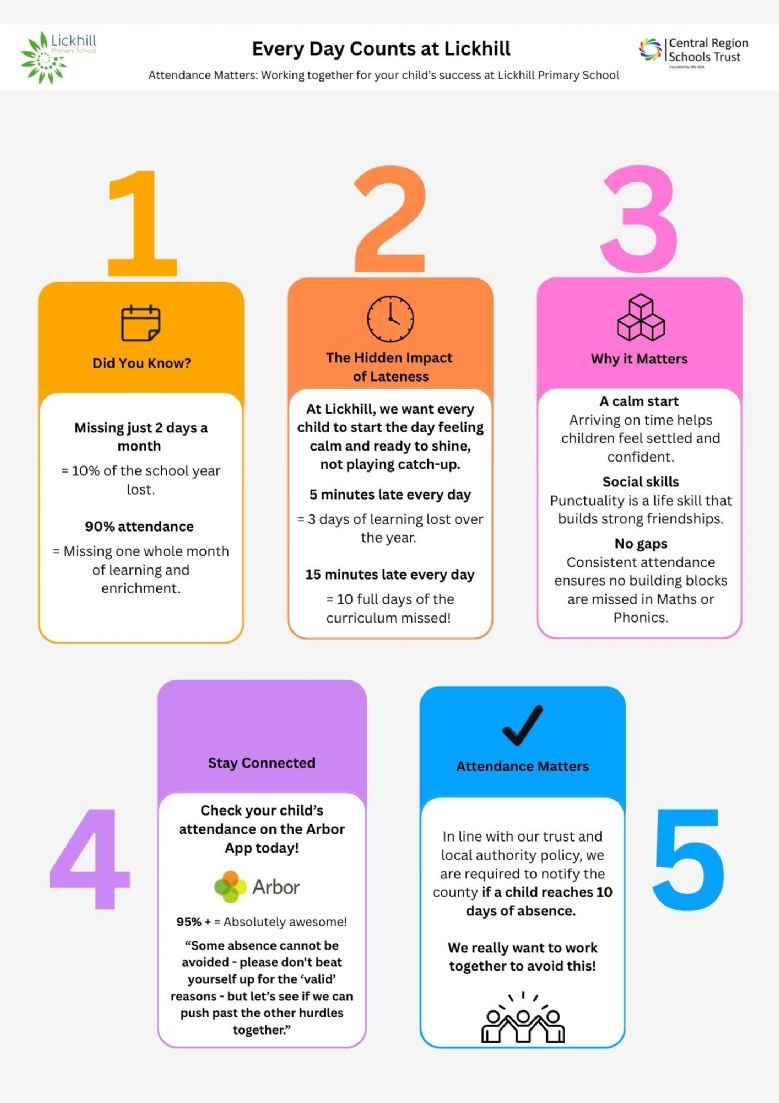
For all of our children to achieve their full learning potential, they need a high level of attendance.
Please help us to maximise your child’s potential by ensuring that if your child has only a minor cold, they still attend school.
If you are unsure of when children should be kept home from school, please use this NHS guide to help you. Is my child too ill for school?
As parents, you have a legal and moral obligation to ensure that your child attends school. In extreme cases, if you fail to do so, legal enforcement action can be taken against you, which could ultimately result in you being prosecuted.
Attendance patterns established at primary age set children up for their time in education and any breaks to this can instll poor habits and lead to issues with truancy as they get older. Any absence needs to be for a valid reason so as not to confuse children from their legal expectation to attend school.
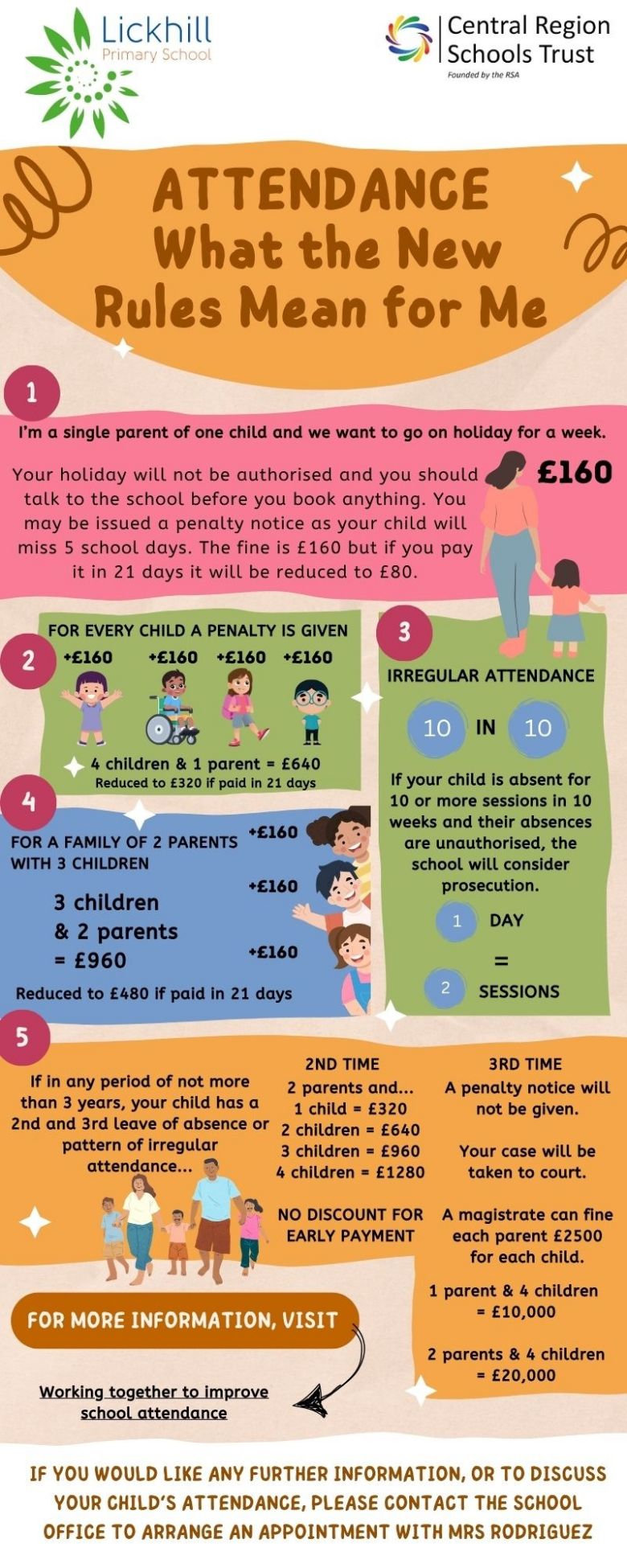
From 19 August 2024, changes to school attendance penalty notices will come into effect under the new National Framework. Penalty fines of £160 per parent, per child (reduced to £80 if paid within 21 days) will be issued for unauthorised absences of 5 consecutive days (10 sessions) or more in a 10-week period.
A second offence within three years will result in the same fine. For a third offence or further offences, cases may be referred to the Magistrates’ Court, where fines can reach up to £2,500 per parent, per child, alongside a possible criminal record. Additionally, unauthorised absences amounting to 10 sessions in a 10-week period may trigger a 20-day “Notice to Improve.”
Parents should avoid term-time holidays and ensure any absences are for a valid, authorised reason to avoid these consequences.
Working Together to Improve School Attendance
Summary of Responsibilities for School Attendance
Is My Child Too Ill to Attend School?
Childhood Infections
Recommended exclusion periods for childhood infections
|
DISEASE |
INCUBATION PERIOD |
PERIOD WHEN INFECTIOUS |
EXCLUSION PERIOD OF INFECTED PERSON |
EXCLUSION OF CONTACTS |
|
Athletes Foot |
Unknown |
Whilst active lesions present |
No exclusion but treatment recommended |
None |
|
Chicken Pox |
11 – 21 days |
1 to 2 days before to 5 days after spots develop |
For 5 days from onset of rash |
None *Female staff see below |
|
Conjunctivitis |
Varies |
None |
No exclusion but treatment is recommended |
None |
|
Cytomegalovirus (CMV) |
3 – 8 weeks |
Someone with CMV infection may shed the virus in body fluid secretions for years |
None |
None |
|
Diarrhoea & Vomiting |
Varies |
Whilst having symptoms of diarrhoea and/or vomiting |
Until symptom free for 48 hours |
None |
|
Diphtheria |
2 – 5 days |
Variable but usually 2 weeks or less |
Until advised clear to return |
HPU to advise |
|
E. coli 0157 |
1 – 6 days |
May be up to 3 weeks in children |
HPU to advise |
HPU to advise |
|
Glandular Fever |
4 – 6 weeks |
Whilst virus is present in the saliva |
None |
None |
|
Hand, Foot & Mouth Disease |
3 – 5 days |
From 2 – 3 days before to a few days after the appearance of rash |
None but contact HPU if large numbers (The presence of a rash does not indicate infectivity) |
None |
|
Head lice |
Eggs hatch in 7 – 10 days |
Whilst lice or eggs remain alive on host |
None. Parents should be advised to treat their child |
None but contacts should be checked |
|
Hepatitis A |
2 – 6 weeks |
From 14 days before to 7 days after the appearance of first symptoms |
Until 7 days from onset of jaundice and the person feels well |
HPU to advise |
|
Hepatitis B |
6 weeks to 6 months |
One month before symptoms to 1 – 3 months after, however it is not infectious under normal nursery conditions (universal precautions should be adhered to) |
Until person feels well |
None |
|
Hepatitis C |
2 weeks to 6 months |
As Hepatitis B |
Until person feels well |
None |
|
Herpes Simplex (cold sore) |
2 – 20 days |
None |
None |
None |
|
HIV |
1 – 12 weeks |
Not infectious under normal nursery conditions (universal precautions should be adhered to) |
None |
None |
|
Impetigo |
4 – 10 days |
Whilst lesions present |
Until lesions crusted/healed or 48 hours after starting antibiotics |
None |
|
Influenza |
1 – 3 days |
Adults 1 day before until 5 days after onset Children 3 days before until 9 days after onset |
Until recovered |
None |
|
Measles |
7 – 14 days |
From a few days before to 4 days after the appearance of the rash |
5 days from onset of rash |
None *Female staff see below |
|
Meningitis (Viral) |
Varies |
Depends on guidance |
Until person feels well |
None |
|
Meningococcal Infection (Meningitis and Septicaemia) |
Varies |
Whilst organism remains in nose or throat. Most cases of infection are acquired from carriers rather than cases |
Until person feels well |
None |
|
Molluscum Contagiosum |
19-50 days |
Whilst lesions are present |
None |
None |
|
Mumps |
12 –25 days (average 18) |
From 6 days before to 9 days after onset of illness |
5 days from onset of swollen glands |
None |
|
Poliomyelitis |
3 – 35 days (average 7–14) |
Whilst organism is present in the stools |
As advised by HPU |
HPU to advise |
|
Ringworm (scalp/body) |
2 – 4 weeks |
Whilst active lesions present |
Exclusion is not required but it is recommended that treatment is commenced before return to school/nursery/childcare setting (Symptomatic pets should also be treated) |
None |
|
Rubella (German Measles) |
14 – 21 days |
7 days before to 6 days after onset of rash |
6 days from onset of rash |
None *Female staff see below |
|
Scabies |
Few days to 6 weeks |
Whilst mites remain alive on the host |
Until 1st treatment completed |
None Treat contacts |
|
Scarlet Fever |
1 – 3 days |
Day sore throat starts to 24 hours after commencing antibiotics |
24 hours from commencing antibiotics |
None |
|
Shingles |
Reactivation |
Until 7 days after rash appears |
Exclude only if rash weeping and cannot be covered (Can lead to chicken pox in susceptible children) |
None |
|
Slapped Cheek (Parvovirus/Fifth Disease) |
4 – 20 days |
Before the rash appears (but probably not afterwards) |
Until clinically well |
None *Female staff see below |
|
Threadworms |
2 – 6 weeks |
Whilst eggs still being produced (Eggs can survive for 2 weeks in the environment) |
None Treatment advised |
None Treatment advised |
|
Tuberculosis |
2 – 10 weeks |
Only when sputum contains bacteria |
Until person feels well and 2 weeks after treatment started (Contact HPU for advice) |
None. Close contacts may be screened |
|
Warts and Verrucae |
2 – 3 months |
Whilst warts are present |
None |
None |
|
Whooping Cough (Pertussis) |
7 – 10 days |
2 – 4 days before until 21 days after start of coughing |
5 days from commencing antibiotic treatment |